
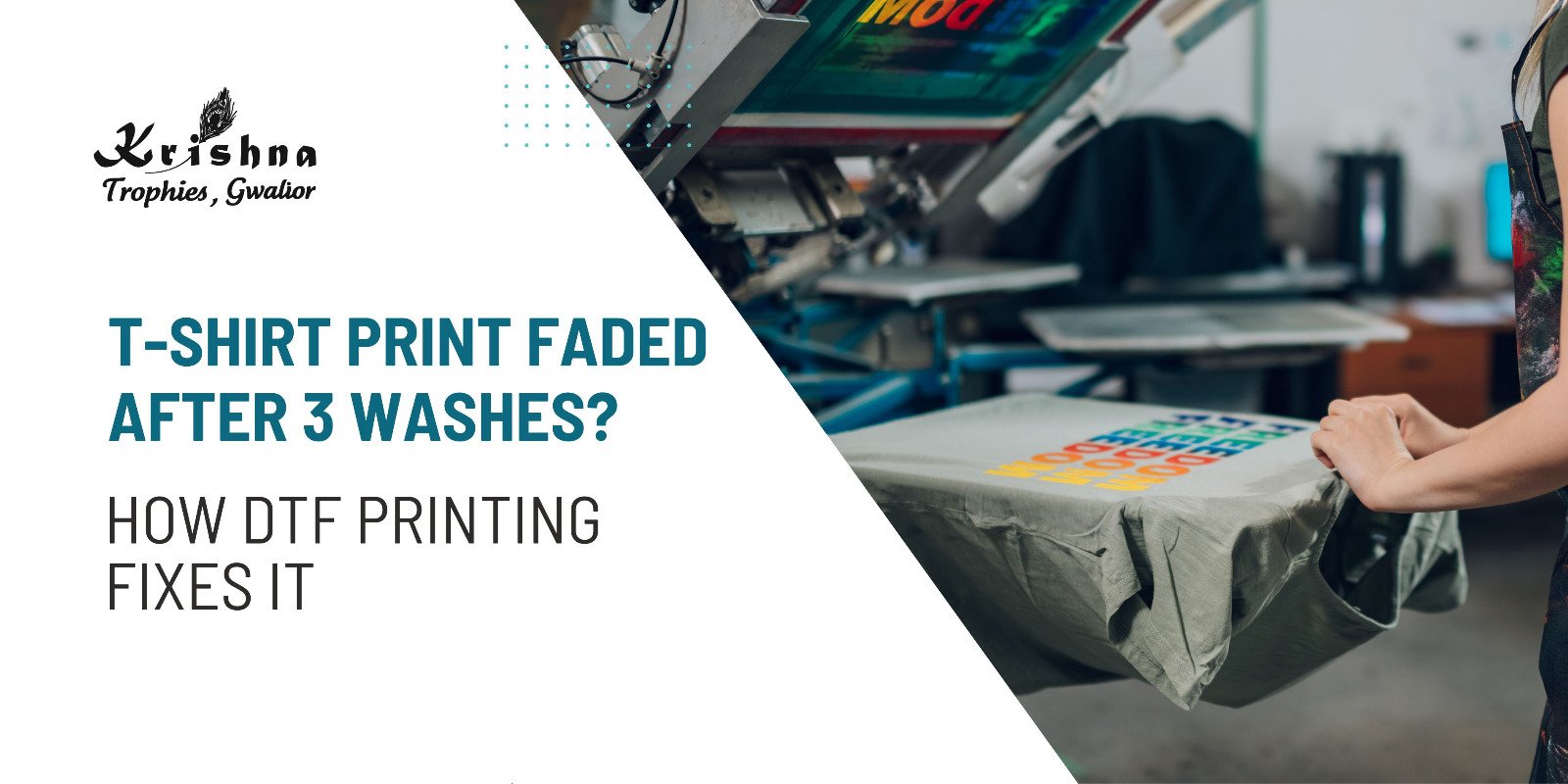
You placed the order. You paid in advance. You collected the T-shirts the day before your event and they looked great.
Then came the third wash.
The logo on the chest started lifting at the edges. The player name on the back turned grey. The colour that looked sharp and vibrant on day one now looks like something left in the sun for six months.
You spent money. You trusted a printer. And now you have 40 faded T-shirts and a sports season still ahead.
This is not a rare story in Gwalior. It happens more often than any printer will openly admit. And the frustrating part is that it is entirely avoidable if the right printing method and process are used from the start.
This article explains exactly why T-shirt prints fade after a few washes, what causes it and how DTF printing quality in Gwalior at Krishna Trophies prevents every single one of those causes.
Why Do T-Shirt Prints Fade So Quickly?
Fading after 2 or 3 washes is not bad luck. It is the result of at least one sometimes several specific mistakes in the printing process. Here are the four most common causes.
Cause 1 - Poor Quality Ink
Not all printing inks are equal. Budget printers in Gwalior often use generic inks that are not specifically formulated for fabric adhesion. These inks sit on top of the fabric rather than bonding with it properly.
The result is predictable. The first few washes loosen the ink’s grip on the fabric fibres. By wash three or four, the design starts breaking down colour shifts, edges lift and the print begins to look worn before the garment itself shows any sign of age.
Quality DTF ink uses pigment-based formulations designed specifically for fabric. Poor quality ink may not adhere effectively to substrates, leading to early fading or washing off. The ink quality is not something visible to the eye when collecting your order but it becomes very visible by the third wash.
Cause 2 - Wrong Heat Press Temperature
DTF printing uses heat to bond a printed film onto fabric. The heat press must reach the correct temperature typically between 160°C and 170°C for the adhesive powder to activate fully and create a permanent bond with the fabric fibres.
Too low the adhesive does not cure properly. The print looks fine initially but starts separating from the fabric after the first few washes. Too high the ink burns, the fabric warps and the print becomes brittle.
Improper curing can affect ink adhesion and washability significantly. A printer cutting corners on time or temperature to rush through more orders produces prints that look identical to correctly cured prints on the day of delivery and completely different three washes later.
Cause 3 - No Colour Profile or Poor Pre-Press Preparation
Before printing, a proper DTF workflow includes colour profiling calibrating the printer output to match the design file accurately. It also includes pre-pressing the fabric to remove moisture and wrinkles before the transfer is applied.
Skipping colour profiles produces colour shifts and uneven ink distribution areas of the print receive too much ink, other areas too little. Uneven ink coverage means uneven adhesion. Some parts of your logo fade faster than others, creating a patchy result that looks worse than a completely faded print.
Pre-pressing removes moisture from the fabric. Moisture trapped under a DTF transfer creates weak spots in the adhesive bond exactly the areas that lift and peel first after washing.
Want to understand the technical words used in DTF printing? Read our complete guide on DTF Printing Terms Explained to learn the meanings of commonly used DTF printing terms in simple language.
Cause 4 - Low Quality PET Film
The film used in DTF printing carries the design from the printer to the fabric. Low quality PET film holds less ink, releases unevenly during heat transfer and produces prints with inconsistent adhesion across the surface.
The foundation of a durable DTF print starts with top-notch components, high-quality PET film, specialised pigment inks and premium adhesive powders. These elements working together help your design transfer smoothly and remain for the long haul.
A printer saving money on film quality is saving money at your expense in the form of prints that do not last.
How Krishna Trophies Prevents Every One of These Problems
Understanding why prints fade is useful. Knowing it will not happen to your next order is better.
Here is exactly what Krishna Trophies does differently for DTF printing quality in Gwalior:
On ink quality: We use pigment based DTF inks specifically formulated for fabric adhesion not generic alternatives. The ink cost is higher. The print lasts significantly longer.
On heat press temperature: Every order goes through a calibrated heat press at the correct temperature and pressure for the specific fabric type. Cotton and polyester have different heat requirements we adjust for each. No shortcuts, no rushing.
On colour profiling: Every design goes through colour profiling before printing. The colour you approve on your digital proof is the colour that transfers to fabric. We also pre-press every garment to remove moisture before the transfer is applied.
On film quality: We use premium PET film with consistent ink absorption and adhesive powder distribution. The result is even adhesion across the entire print surface, no weak spots, no early lift points.
On design proof: Every order whether it is 5 pieces or 500 receives a digital proof for approval before production begins. You see exactly what will be printed before a single garment goes into production.
What the Numbers Actually Say About DTF Print Durability
This is not a marketing claim. It is tested and documented.
High-quality DTF prints can typically withstand 50 to 100 wash cycles without significant fading, cracking or peeling. Test results specifically showed that black DTF prints washed approximately 52 times without fading, still looking fresh.
The difference between a print that fades after 3 washes and one that lasts 50 plus washes is not the printing method. It is the quality of the materials and the precision of the process.
A cricket jersey that lasts a full season costs the same to print as one that fades by the third match. The only difference is who you order from.
The Practical Care Side - What You Can Do
Even the best DTF print needs basic care to reach its durability potential. This is not complicated:
- Wash cold – hot water breaks down the adhesive bond faster
- Wash inside out – protects the print surface from mechanical friction in the drum
- Use mild detergent – avoid bleach and fabric softeners
- Air dry or low heat tumble dry – high heat can soften the adhesive
- Never iron directly on the print – iron inside out or use a protective cloth
Follow these and your Krishna Trophies DTF print will outlast most of the garments it is printed on.
DTF Printing vs Screen Printing in Gwalior — Which is Better?
One Last Thing Before Your Next Order
If you had a bad experience with printed T-shirts in Gwalior; fading, peeling, cracking after a few washes, that experience reflects the process of whoever printed them. It does not reflect what DTF printing is capable of when done correctly.
When done right, DTF printing is one of the most durable digital garment decoration methods available today. With the right setup and care, your designs will not just look good, they will last.
Over 500 schools, sports clubs and businesses in Gwalior have placed repeat orders with Krishna Trophies since 2008. Repeat orders are the only honest measure of print quality nobody reorders from a printer whose prints faded after 3 washes.
WhatsApp: +91-975-202-0535 Address: C-1, Rajnigandha Enclave, Gola Ka Mandir, Morar, Gwalior — 474005, Madhya Pradesh Hours: Monday to Saturday, 10 AM – 7 PM