You found a printer in Gwalior. You know what you want printed. You are ready to place your order.
Then the conversation starts. PET film. Hot peel. Colour profile. GSM. CMYK.
Suddenly ordering a T-shirt feels like passing a technical exam.
It should not. Most DTF printing terms are straightforward once someone explains them in plain language – without assuming you spent three years in a print shop.
This glossary covers 15 terms you will encounter when ordering DTF printing in Gwalior at Krishna Trophies or anywhere else. Each definition is written for a school teacher, sports coach or business owner in Gwalior – not a printing technician.
Read it once. Bookmark it. Come back when a term confuses you mid-order.
1. DTF Printing
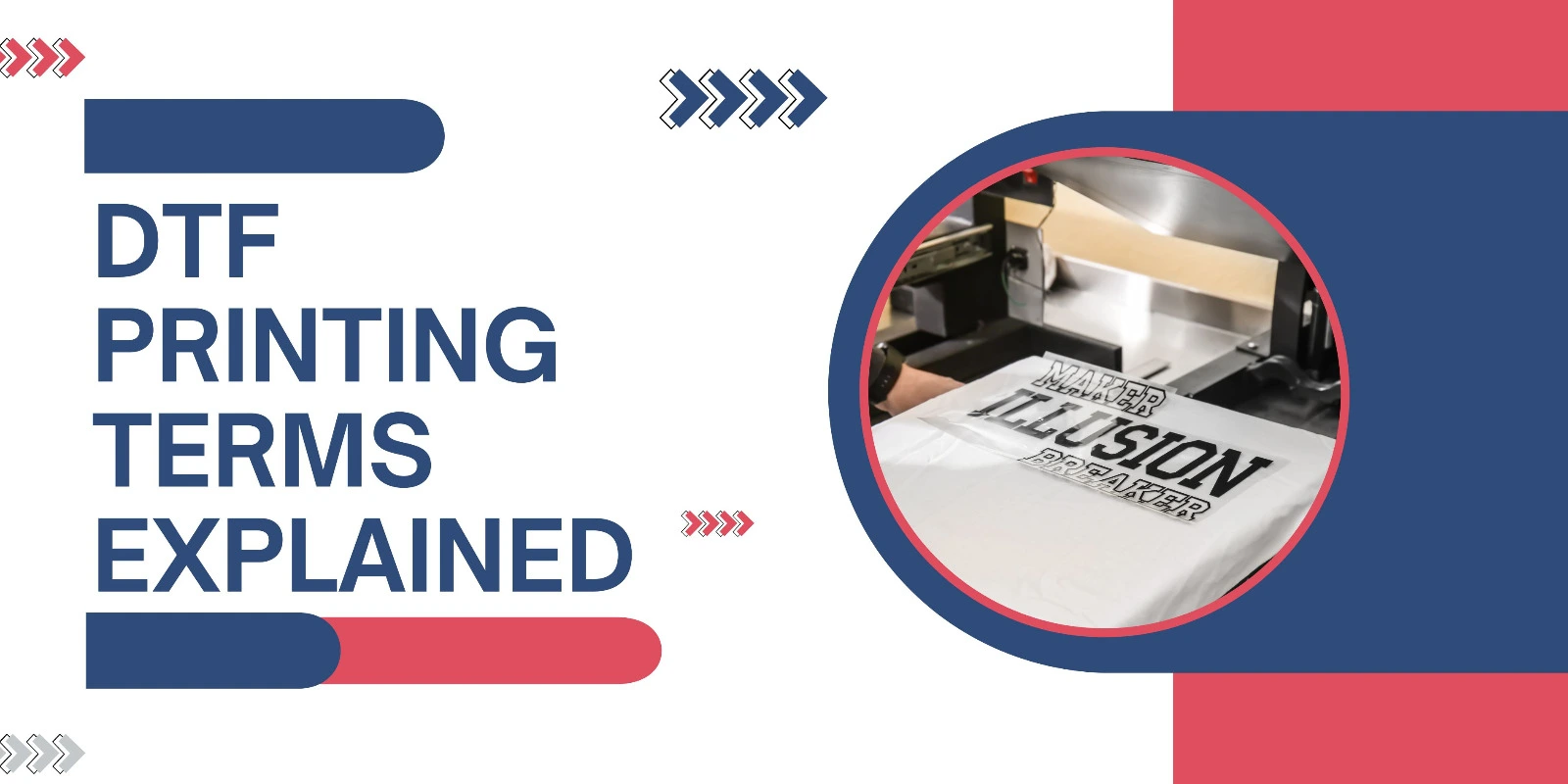
Direct to Film printing a method where your design is first printed onto a special plastic film, then transferred onto fabric using heat and pressure.
Think of it like a temporary tattoo process except permanent, wash-durable and works on any fabric colour or type. A school in Gwalior ordering uniform T-shirts for annual day or a cricket club ordering jerseys both use this same process to get sharp, vibrant prints delivered fast.
2. Direct to Film
The full name behind the abbreviation DTF. “Direct to Film” describes the first step the design goes directly onto the film before it reaches the fabric.
This is different from Direct to Garment (DTG) printing, where ink goes straight onto the fabric. DTF uses a film as the transfer medium, which is why it works on fabrics that DTG cannot handle well polyester, blends and dark-coloured garments.
3. PET Film
PET stands for Polyethylene Terephthalate, a thin, heat-resistant plastic film that carries your design from the printer to the fabric.
PET film is the surface your design is printed onto before the heat press bonds it to the T-shirt. High-quality PET film, specialised pigment inks and premium adhesive powders work together to help your design transfer smoothly and remain for the long haul. Poor quality PET film is one of the main reasons T-shirt prints fade after a few washes the film releases the design unevenly onto the fabric.
4. Hot Peel
Hot peel means the PET film is peeled off the fabric immediately after the heat press – while the transfer is still warm.
Hot peel transfers are designed to release cleanly from the fabric at high temperature. They are faster to process, which matters for bulk orders. If a hot peel film is used incorrectly with a cold peel process or vice versa the print quality suffers. Your printer should know which film type they are working with.
Want premium quality T shirt and garment printing in Gwalior? Read our complete guide to DTF Printing Near Morar, Lashkar, and Thatipur for expert insights and printing solutions.
5. Cold Peel
Cold peel means the PET film is left to cool completely before being peeled off the fabric after heat pressing.
Cold peel generally produces a slightly softer feel on the print surface. It requires more time per piece because the transfer must cool before peeling. For large bulk orders with tight deadlines, hot peel is more common. For premium quality orders where feel and finish matter corporate merchandise, branded polos cold peel is often preferred.
6. Heat Press
A heat press is the machine that bonds the printed PET film onto the fabric using a combination of heat, pressure and time.
Think of it as a very precise industrial iron. Temperature, pressure and pressing time must all be calibrated correctly for the specific fabric being printed. Improper curing including wrong temperature or timing can affect ink adhesion and washability significantly. A heat press that is even slightly off-temperature produces prints that look fine on day one and fade or lift within a few washes.
7. Print Density
Print density refers to how much ink is deposited per unit area of the design – essentially how solid and vibrant the colours appear on the final print.
High print density produces rich, opaque colours – important for dark fabrics and designs with large colour areas. Low print density produces lighter, more transparent colour application. For a cricket team’s jersey printing in Gwalior where the club logo needs to stand out clearly on a dark jersey, print density directly affects how visible and professional the final result looks.
8. Colour Profile
A colour profile is a set of instructions that tells the printer exactly how to reproduce each colour in your design file on the specific ink system being used.
Without a colour profile, the printer makes its own interpretation of your colours. The blue in your school crest might print as slightly purple. The red for your cricket club logo might shift towards orange. A correct colour profile maps your design colours to the printer’s output accurately. This is why Krishna Trophies sends a digital proof before every order so you confirm colour accuracy before production starts.
Read real customer experiences in our article, “What Gwalior Customers Say About Krishna Trophies – Real Reviews.”
9. GSM Fabric
GSM stands for Grams per Square Metre, the measurement used to describe how heavy or light a fabric is.
Lower GSM means lighter, thinner fabric. Higher GSM means heavier, denser fabric. For printed T-shirts in Gwalior, common GSM ranges are 160 to 180 GSM for standard cotton T-shirts and 130 to 150 GSM for dry-fit polyester sports jerseys. GSM affects how the print feels on the garment, a heavier fabric generally produces a more substantial, premium result.
10. Sublimation Printing
Sublimation is a printing method where heat converts ink into gas, which bonds permanently with polyester fibres, producing prints with no texture or raised surface.
Sublimation produces beautiful all-over prints on polyester; the colour becomes part of the fabric itself. However, it only works on light-coloured polyester fabric. On cotton or dark fabrics, sublimation does not work at all. DTF printing works on all fabric colours and types, making it the more versatile choice for most schools and sports clubs in Gwalior ordering mixed fabric requirements.
11. Screen Printing
Screen printing pushes ink through a mesh screen onto fabric one colour at a time, using a separate screen for each colour in the design.
Screen printing is extremely durable and cost-effective for very large orders of identical designs, 500 pieces with one or two colours. It becomes expensive for small quantities because each screen costs money to produce regardless of how many pieces are printed. For most Gwalior school and sports club orders under 200 pieces with multi-colour designs, DTF is more practical and cost-effective.
12. Vector File
A vector file stores your design as mathematical equations rather than pixels meaning it can be scaled to any size without losing quality or becoming blurry.
Common vector formats are AI (Adobe Illustrator) and PDF. If your school has its crest saved as a vector file, that crest will print sharp at any size whether it is 5cm on a collar or 30cm across the back of a hoodie. Vector files are the gold standard for logo printing. If your designer created your logo, ask them for the AI or PDF version and keep it saved somewhere accessible.
13. Raster File
A raster file stores your design as a grid of individual pixels, like a photograph. Quality is fixed at the resolution it was created at and cannot be improved by making the file larger.
JPG and PNG are raster formats. A raster file at 300 DPI prints sharply at its intended size. The same file enlarged beyond its intended size becomes pixelated and blurry. This is why a logo screenshot from a website typically 72 DPI produces a fuzzy print when enlarged to jersey-print size. When sending design files for DTF printing, raster files must be at minimum 300 DPI at actual print size.
14. CMYK
CMYK stands for Cyan, Magenta, Yellow and Key (Black) , the four ink colours used in traditional offset printing to reproduce the full visible colour spectrum.
Most professional design software defaults to CMYK for print work. However, DTF printing processes colour in RGB mode, the same mode used by screens and digital displays. Sending a CMYK file for DTF printing can cause subtle colour shifts, particularly in blues, greens and purples. When preparing your design file, set the colour mode to RGB for the most accurate DTF output. If your file is in CMYK, mention it when sending, we convert before printing.
15. Washfastness
Washfastness is the measure of how well a printed colour resists fading, bleeding or changing during washing.
High washfastness means the print maintains its original colour and quality through multiple wash cycles. High-quality DTF prints can typically withstand 50 to 100 wash cycles without significant fading, cracking or peeling. Washfastness is affected by ink quality, curing temperature, fabric type and how the garment is washed. Cold wash, inside out, mild detergent, these three habits protect washfastness on every DTF printed garment from Krishna Trophies.
You Now Know More Than Most People Who Order T-Shirt Printing in Gwalior
Seriously. Most buyers place orders without knowing what PET film is, why colour profiles matter or what GSM means for their garment choice.
Knowing these terms does not make you a printing technician. It makes you a better buyer, one who asks the right questions, understands what is being done and can spot the difference between a printer who knows their process and one who is cutting corners.
When something in your next order does not look right on the proof, you now know why, and you know how to describe it clearly.
WhatsApp: +91-975-202-0535 Address: C-1, Rajnigandha Enclave, Gola Ka Mandir, Morar, Gwalior 474005, Madhya Pradesh Hours: Monday to Saturday, 10 AM – 7 PM